

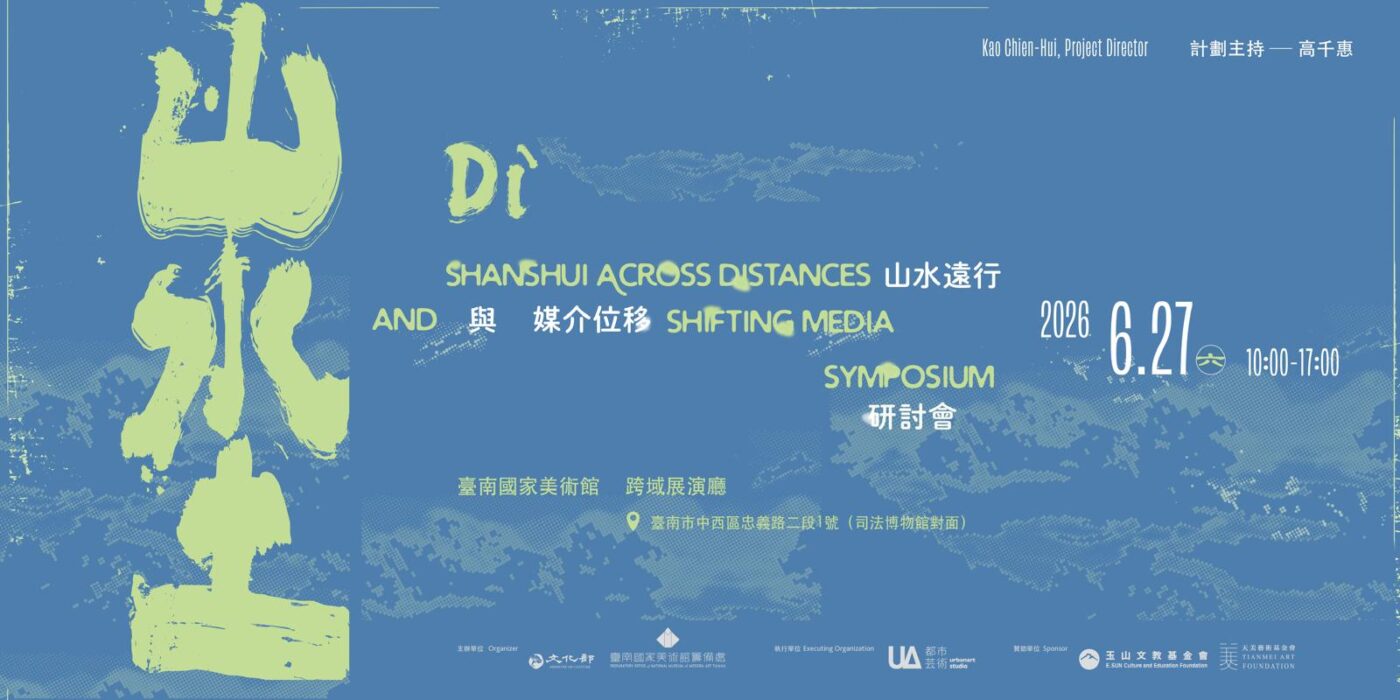
“Di: Shanshui Across Distances and Shifting Media” symposium.
(Image courtesy of Preparatory Office of National Museum of Modern Art Tainan)
The Intermediality of “Ink” as Medium
「墨」作為介質的跨媒介性
YANG Chia-Ling 楊佳玲
Professor, School of History of Art, University of Edinburgh
Excerpted from “Where Ink Exhausts: Transformative Shanshui Across Media.” Di: Shanshui Across Distances and Shifting Media, Published in 2026 June.
Here, “ink” does not denote pigment, but functions as a conceptual principle of transformation and intermedial thinking. It designates a generative state in which material, form, and meaning remain in continuous negotiation and flux. Within this framework, landscape ceases to be an object of representation and instead operates as a performative, trans-material ecology, structured through processes of flow, layering, and temporality that shape perception and experience. This formulation resonates with Victor Turner’s notion of “liminality,” wherein contemporary ink shanshui art may be understood as a threshold space suspended between dissolution and reconstitution, neither fully embedded within existing structures of reality nor stabilised into a new system of meaning. 1
In the work of printmaker YANG Chung-Ming, “ink” is reconfigured as an ecological and material phenomenon. Taking printmaking as a methodological point of departure, he expands the boundaries of the medium by integrating traditional papermaking techniques with contemporary investigations into the fibrous structure of paper and its vegetal origins. In this process, paper and ink are no longer passive supports for images, but become material entities bearing temporality and material memory. Printmaking thus shifts from a logic of reproduction toward an experimental field responsive to material processes and labor, while formally disrupting the planar structure of landscape.
YANG’s series often begins with reflections on text and language, which are subsequently translated into visual form, a process the artist describes as “landscapes generated from text.” Since 2019, in collaboration with the Taiwan Forestry Research Institute, he has developed an original watermark technique, layering multiple sheets of watermark paper onto unsized white paper. As light passes through the surface, interwoven watermark patterns and paper fibers gradually emerge, producing subtle and intricate visual textures. The Timeless Narrative: Walking Through series, realised through this method, reinterprets botanical imagery from Honzō zufu (Illustrated Herbal Encyclopaedia), a botanical atlas compiled by the Japanese botanist Iwasaki Tsunemasa (1786-1842), allowing botanical knowledge, the materiality of paper, and the temporality of light to intertwine within the work.
Initiated in 2023, the Flora of Formosa series adopts a method that integrates perception, technique, and material translation. The process begins with photographing spatial models under controlled, realistic lighting conditions, followed by transforming the images into dynamic visual flows within digital software. These are then transferred onto handmade watermark paper through a customized stencil technique. This procedure simulates an artificial light environment, enabling the flat image to seamlessly integrate into real micro-spatial conditions, while continuously shifting in response to changes in viewing position and light. In this context, “ink” no longer exists as a singular material, but operates across paper, light, and image as an intermedial process.
Focusing on how art operates through light, paper, fiber, and spatial installation, YANG Chung-Ming’s works, such as Flora of Formosa: Paradise Greenhouse (2023) and Flora of Formosa: Under the Moon: Grape-Leaved Anemone (2024), transform viewing into an embodied experience.” Image and form emerge, recede, and shift in response to changes in light, position, and time, echoing the unfinished, unknown and unpredictable natural state inherent in the integrated process of papermaking and image development. In contrast to traditional printmaking grounded in ink, YANG emphasizes light as the primary condition of image development, through which images materialize, drift, and transform through their interaction with material substrates. The work no longer presents a fixed image, but unfolds through the act of viewing, producing a delicate, almost ethereal visual texture that redefines printmaking as a temporal and perceptual practice.

YANG Chung-Ming, Flora of Formosa: Paradise Greenhouse, Watermarked handmade paper, 52×26 cm, 2023

YANG Chung-Ming, Flora of Formosa: Under the Moon: Grape-Leaved Anemone, Linocut, Watermarked handmade paper with natural dye, 60×15.8 cm, 2024
In YANG’s work, The Lost Shoreline (2025), the image is constructed through layered sheets of paper: a boy walks along the crest of a wave, solitary and ambiguous, at once distinct and diffuse. The black employed here is not traditional ink, but the paper itself, formed from fibers dyed with logwood tree plants.
His innovative technique integrates watermark papermaking, screen printing, and LED light panels. Developed over three and a half years of research and scientific collaboration with the Taiwan Forestry Research Institute, this process transforms paper from a passive support for the image into the subject of the work; details of the image are completed as the pulp takes shape. In this process, material generation is no longer merely a technical operation, but becomes an experiential spatial practice. From a phenomenological perspective, this may be understood in relation to Gaston Bachelard’s The Poetics of Space, in which material processes give rise to a microcosmic world where matter, imagination, and embodied perception resonate. 2
-1400x713.jpg)
YANG Chung-Ming, Flora of Formosa: The Lost Shoreline, Watermarked handmade paper, natural dye, LED, 06×57×4 cm, 2025
As the artist notes: “Paper need not serve any tool; it is papermaking, image, and discourse in itself.” 3 Through controlling the flow, gathering and dispersal of plant fibers, tonal variation emerges from within the material, displacing the gestural dynamics force of traditional brush and ink on paper. “Ink” thus becomes a state internal to the material process itself. YANG further asks: Is it possible to dispense with ink while retaining its expressive resonance? Can the work achieve a state of total simultaneity at the very moment of the paper’s formation? Within an uninked field of white, can an Eastern aesthetic still be conveyed in a contemporary context while also carrying a distinctly Taiwanese cultural specificity? 4
In YANG Chung-Ming’s Flora of Formosa: Unspoken Chapter (2024), the artist employs dye derived from the logwood to produce a form of “non-ink,” thereby re-conceptualizing ink as a material bearing cultural and national connotations. No longer functioning as a medium for writing or painting, it operates instead as an intermedial state of being. “Non-ink” here exists in a state of continual transformation, in which material, form, and meaning are in constant negotiation and transition. The work does not point toward a fixed or completed image; rather, it unfolds through processes of flow, layering, and temporality, gradually shaping the viewer’s perceptual experience. Within this framework, landscape ceases to function as a pictorial genre and instead emerges as an ongoing phenomenon.
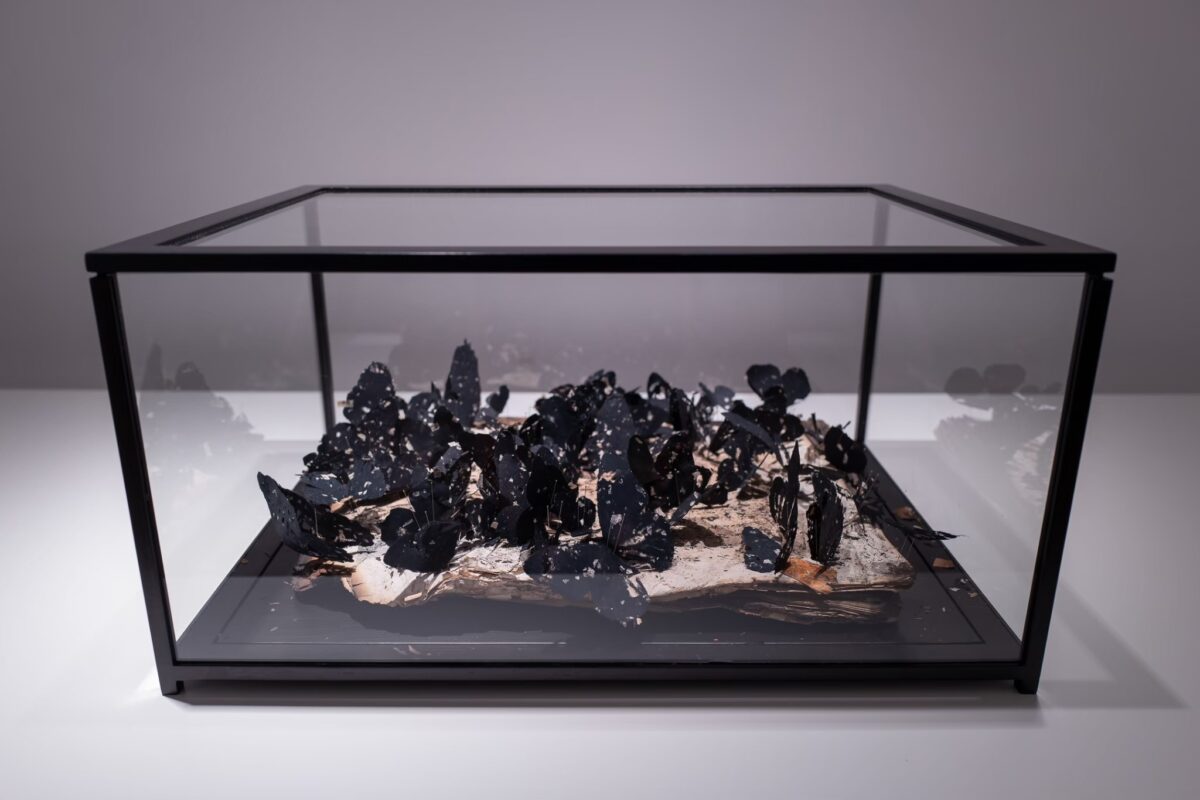
YANG Chung-Ming, Flora of Formosa : Unspoken Chapter, Watermarked handmade paper, natural dye, charred book, 44×32×20 cm, 2024
The work is grounded in books damaged in the fire at Songlin Bookstore in Taipei, bearing traces of depleted knowledge and time. Upon this surface, the form of “ink butterflies” is randomly dispersed. Fragments of burned text fall unpredictably during the dyeing process and gradually become embedded within the wings of these butterflies. In this process, language no longer refers to semantic meaning, but is transformed into a purely visual presence. Within YANG’s work, butterflies emerge from ash and absence, suggesting a quiet, restrained form of regeneration. The translucent layering, and fragmented text resonate with a poetic sensibility: the work neither narrates nor explains, but instead preserves a space for contemplation, impermanence, and a shared solitude.
Here, “ink” no longer belongs to the established category of ink painting, and “paper” is no longer merely a support for images. Ink-making, papermaking, rubbing, and viewing are situated within a shared temporal field, forming an open material system. This non-linear, non-teleological process unfolds according to the internal rhythms of materials themselves, as fibers, ink, light, and ash intertwine. Within this interplay, time is experienced as something not fully governed by language, preserving memory through continuous transformation.
Each butterfly in the work bears fragments of charred text upon its body, remnants of language and the reanimation of memory. This constitutes a landscape of flight and residue, in which the boundaries between writing and image, presence and trace, dissolve. YANG Chung-Ming’s practice thus articulates a post-medium conception of landscape: ink is no longer a discrete material, but an ongoing process; paper ceases to function as a passive support and instead assumes the qualities of a living, organic presence; landscape, in turn, is no longer an object of representation, but a performative, liminal field. In this sense, the work may be read alongside Homi K. Bhabha’s notion of the “Third Space,” a site of cultural hybridity and negotiation in which the philosophy of ink painting is translated and reconfigured through new material vocabularies and technological conditions. 5
註釋
1 | Turner, Victor. “Liminality and Communitas.” In The Ritual Process: Structure and Anti-Structure, 94-130. Chicago: Aldine, 1969.
2 | Bachelard, Gaston. The Poetics of Space. Translated by Maria Jolas. Boston: Beacon Press, 1994.
3 | YANG Chung-Ming, interview by the author, October 15, 2025.
4 | Ibid.
5 | Bhabha, Homi K. The Location of Culture. London: Routledge, 1994.
|Source|
Publication |Di: Shanshui Across Distances and Shifting Media
Text | Professor YANG Chia-Ling 楊佳玲 教授
Publisher | Preparatory Office of National Museum of Modern Art Tainan
Images | Gallery de sol

 中文
中文